In this guide
Goalkeeping is a different job. A brilliant striker can be a disaster in goal, and a regular keeper may be an average outfield player. If your balancer treats everyone as interchangeable, the team with the keeper wins. Rostara handles this in three ways: it rates goalkeeping as its own skill, it knows how much of a game each player spends in goal, and it can mark specific players as the keeper for a game and spread them across the teams.
The usual goalkeeper situations
| Situation | What usually works | How to set it up in Rostara |
|---|---|---|
| Two keepers, two teams | One each, then balance the outfield. | Mark both as fixed goalkeepers for the game. With keeper balancing on, they go to different teams. |
| One keeper, two teams | The keeper's team gets a slightly weaker outfield; the other team rotates. | Mark the one keeper as fixed. The other team is treated as rotating, and the balancer offsets the difference in the outfield. |
| Three keepers, two teams | One keeper per team; the third plays outfield. | Mark only the two who will actually stay in goal as fixed. The third keeps their usual goal share and is balanced as an outfield player. |
| Nobody wants to go in goal | Rotate every few minutes, or after each goal conceded. | Leave nobody fixed. Every player's goalkeeping rating counts in proportion to how much they usually play in goal. |
Rotation schemes that groups use: swap every five to eight minutes, swap at half-time, or the player who concedes goes in next. Whatever you choose, a goal-share setting (below) tells the balancer roughly how much each person will be in goal.
Goal share: how much each player is in goal
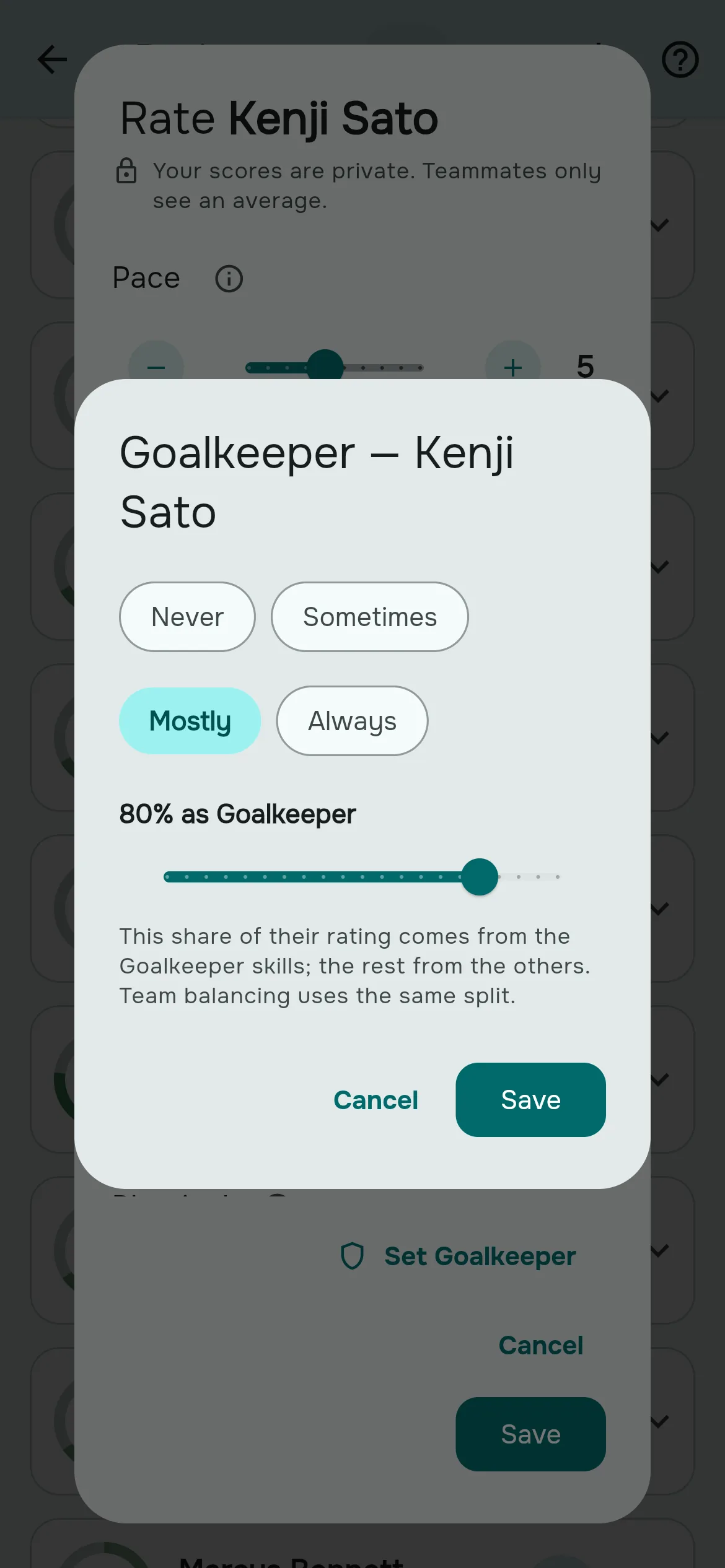
Every player has a goal share: the part of a game they usually spend in goal, from 0% to 100%. It decides how much their goalkeeping rating counts compared with their outfield skills, both in their overall rating and in team balancing. For soccer and futsal the presets are:
| Preset | Share | Who it describes |
|---|---|---|
| Never | 0% | Outfield only. Their goalkeeping rating is ignored. |
| Sometimes | 20% | Takes a turn when the team rotates. |
| Mostly | 80% | The usual keeper who sometimes plays out. |
| Always | 100% | A dedicated keeper. |
Handball and ice hockey use Never (0%), Sometimes (25%) and Always (100%). You can also fine-tune it in 5% steps.
Here is how it changes a rating. A player rated 6.5 on average across the outfield skills and 4 in goal comes out at 6.5 overall with "Never", 6.0 with "Sometimes" (80% of 6.5 plus 20% of 4) and 4.0 with "Always".
Set a player's usual goal share
- Go to Group → Ratings and tap Rate (or Edit) on the player.
- In the rating dialog, tap Set Goalkeeper.
- Pick a preset or use the slider, then tap Save.
Mark the keeper for one game
A usual share is a good default, but on the night you know who is going in goal. Organizers can set that per game without changing anyone's usual role:
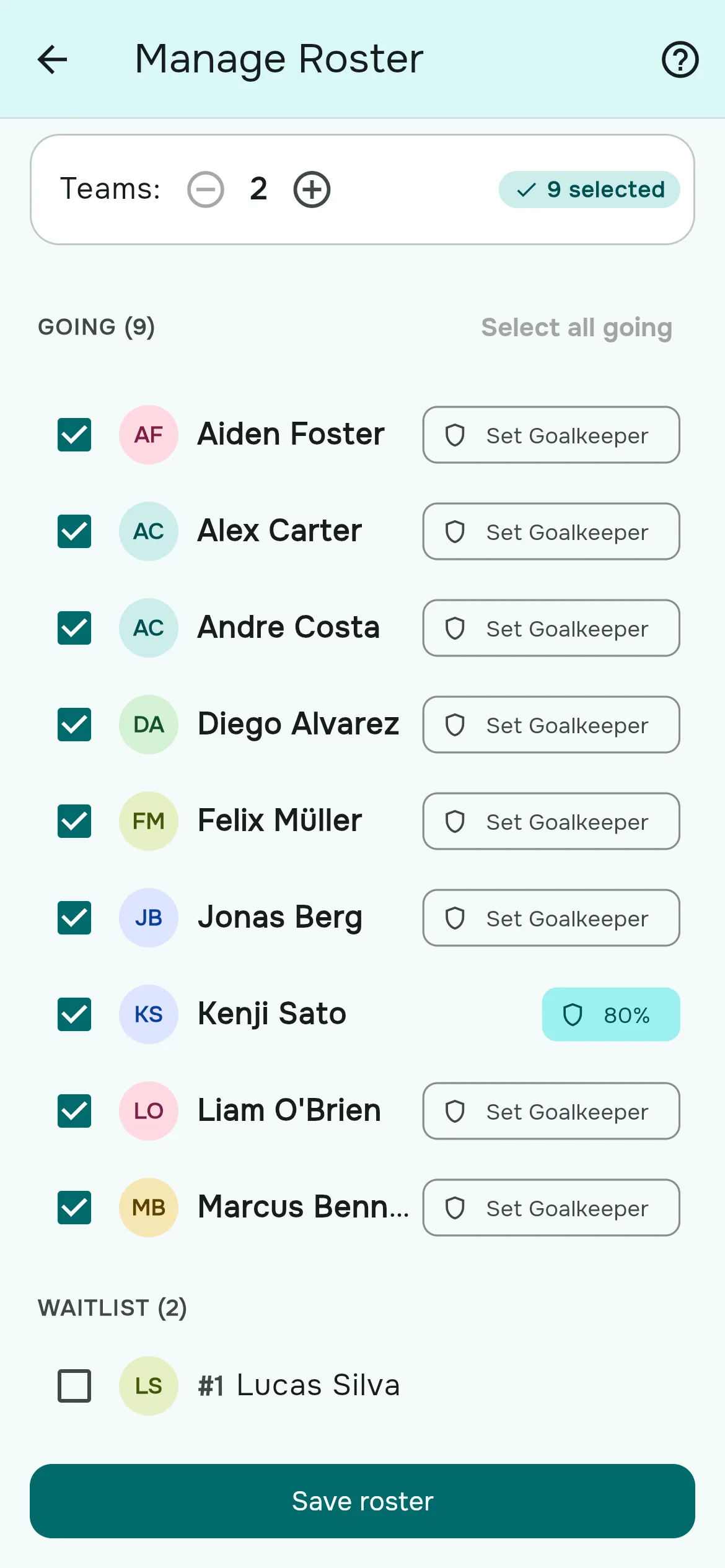
- On the game page, open Manage Roster.
- Tap the Set Goalkeeper chip next to a selected player.
- Switch on Fixed Goalkeeper ("This player is the keeper for the whole game; teammates play the field") and tap Save, then Save roster.
The chip then shows the share, for example 80%. You can do the same from the Suggest Teams screen: tap a player and choose the line that reads, for example, "80% as Goalkeeper". Turning Fixed on with a low share raises it to at least the "Mostly" preset.
Spread keepers across the teams
The group setting Balance Goalkeeper across teams ("Spread designated keepers evenly so one team doesn't get them all") is on by default. When it is on, fixed keepers are divided as evenly as possible: with two keepers and three teams, no team gets both and the third team rotates. With four keepers and two teams, each gets two.
If someone builds teams by hand that break this, for example both keepers on one side, submitting them for a vote is refused with "Goalkeepers aren't balanced. Spread the designated keepers evenly across the teams."
Find it in Group Settings → Skills, under Specialist position. You can also rename the position there. The name appears throughout the app, so a hockey group can call it "Goalie".
How keepers affect the balance score
- A team with a fixed keeper: goalkeeping is measured on that keeper alone, and their teammates count fully as outfield players.
- A team without one: everyone counts towards goalkeeping by their goal share and towards the outfield by the rest.
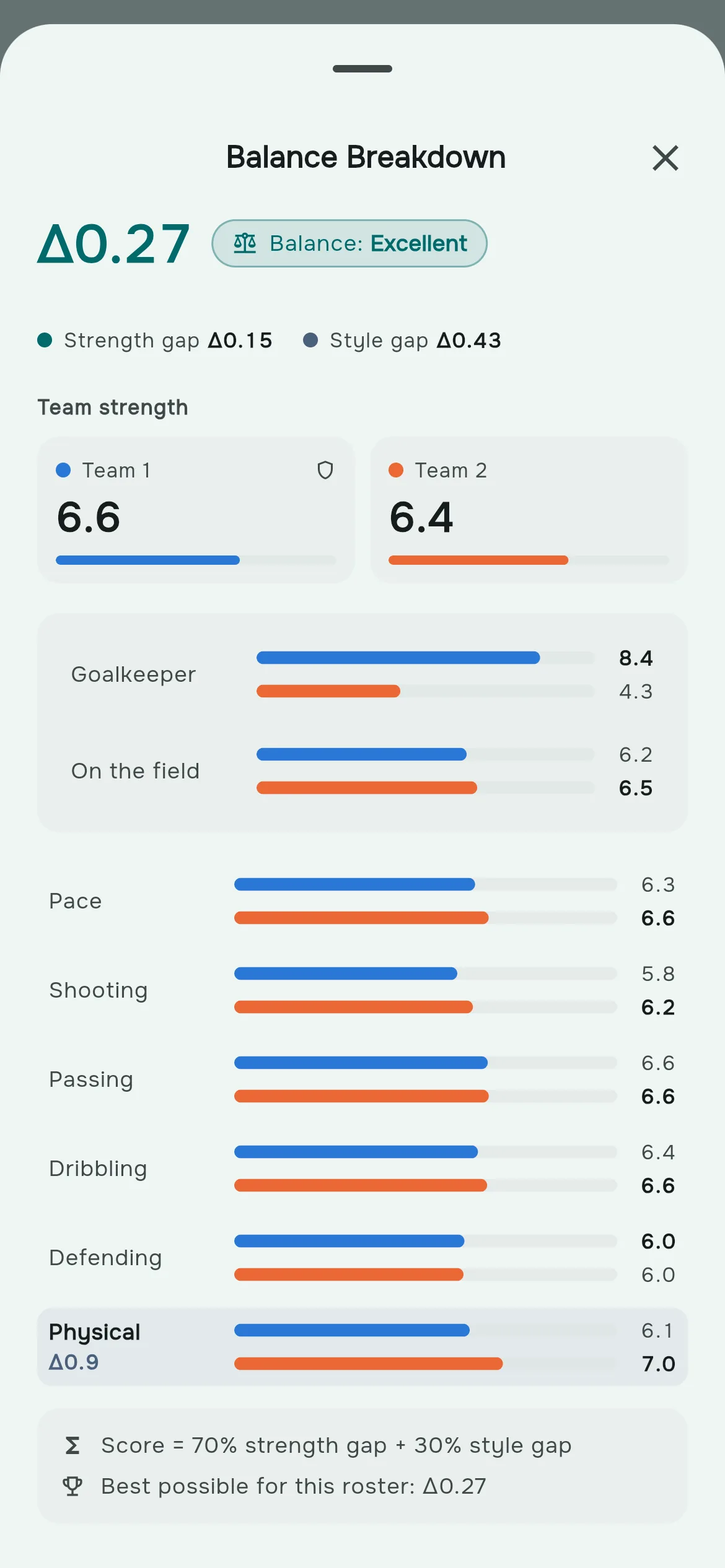
- Team strength blends the two halves by how much of the game is spent in goal. A team with a better keeper can be balanced by a slightly weaker outfield.
- The skill-by-skill comparison uses outfield skills only, so goalkeeping enters through overall strength.
The Balance Breakdown shows a separate row for the goalkeeper and the outfield, and a shield marks fixed keepers on the teams.
Basketball, volleyball and other sports
Only sports with a goalkeeping skill show any of this: soccer, futsal, handball and ice hockey. Basketball, volleyball, padel and tennis groups never see keeper settings. If your sport has a different specialist, such as a libero, an organizer on Rostara Pro can mark a skill as belonging to the specialist position and rename it. See custom skills and sport presets.
Questions organizers ask
Will the balancer give one team both keepers?
Not for players marked as fixed goalkeepers while "Balance Goalkeeper across teams" is on, which is the default. They are spread as evenly as the numbers allow.
We have two keepers and three teams. What happens?
Each keeper goes to a different team and the third team rotates. The balancer evens out the difference with the outfield players.
Does a great keeper unbalance the teams?
The balancer offsets a stronger keeper with a slightly weaker outfield. If you'd rather match the outfield skills more closely too, lower Balance priority in Group Settings.
Does a high goal share make someone the keeper?
No. Only "Fixed Goalkeeper" on the game's roster marks someone as the keeper for placement. The goal share just weights their ratings.
Does setting a keeper for one game change their usual role?
No. Per-game settings live on that game's roster. The usual share is set from the Ratings page.
Who can set goalkeepers?
The group's owner and admins.
Does 5-a-side include a goalkeeper?
Most 5-a-side and futsal formats do: four outfield players and a keeper. Some casual games play rush goalie, where whoever is closest defends the goal. In Rostara, use goal shares for rush-goalie games and fixed keepers when someone stays in goal.
Why don't I see goalkeeper options?
Your group's skills have no goalkeeping skill (basketball or volleyball, for example), or you aren't an admin of the group.